
Physical Security Integrated Management
Biometric Solutions
Biometric access control.
Fingerprint access control, facial recognition and touchless biometrics, integrated with enterprise security.
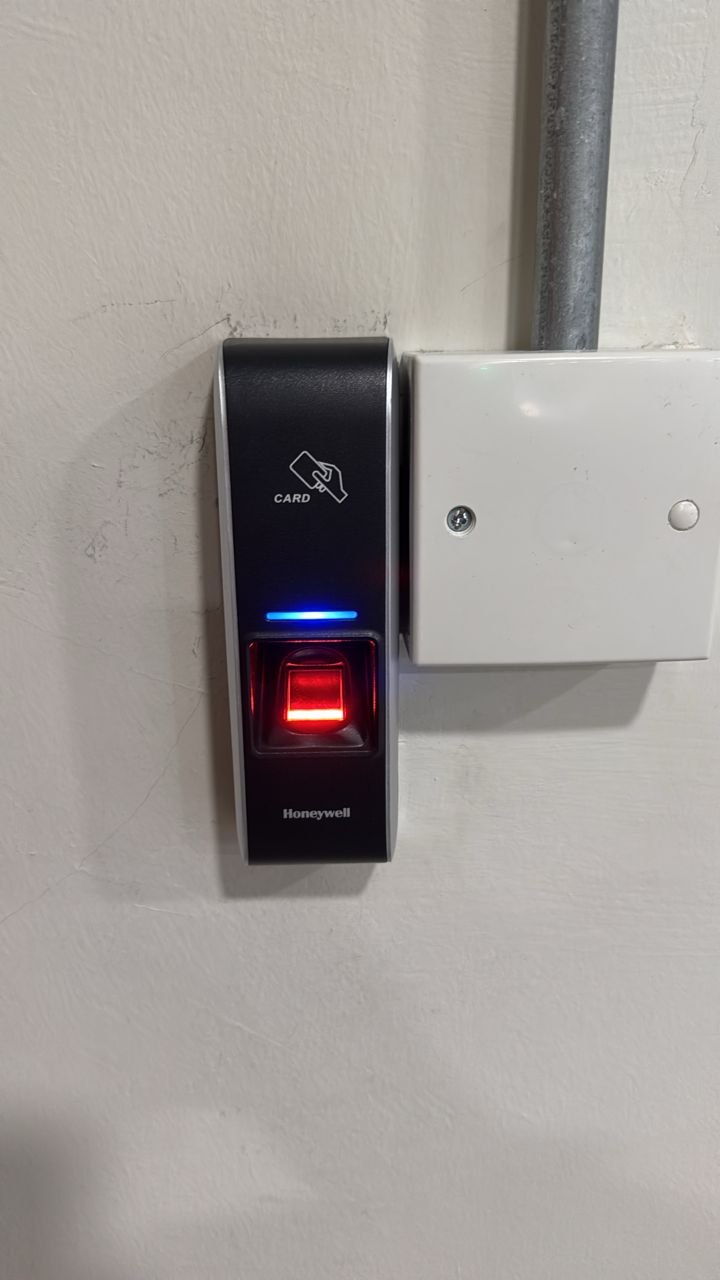
Identity at the door
Verify the person behind the credential.
Traditional card access control verifies the credential presented at the door. Biometric access control adds another layer of security by verifying the identity of the person requesting entry.
Fingerprint recognition, AI-powered facial authentication and contactless biometric technologies can reduce the risks associated with lost, shared, borrowed or cloned access cards. Responsible biometric data management is an important part of enterprise security system design.
We integrate fingerprint, touchless and face recognition terminals with your access control platform. Where supported by the selected systems, users can be enrolled centrally and their access synchronised across doors. Many terminals also support cards, PINs or QR codes, depending on the model and configuration.
Reduce credential sharing
Tie access to an enrolled person and reduce reliance on cards that can be lost, lent or copied.
Protect sensitive areas
Combine biometrics with a card or PIN for server rooms, vaults and controlled zones.
Improve attendance records
Reduce buddy punching, where one employee clocks in for another, through identity verification.
Reduce card administration
Use biometric credentials where suitable to reduce the number of cards to print, replace and manage.
Choose by entrance
Choosing the right biometric.
The right choice depends on the door, the environment and the people using it. Performance also depends on the selected terminal and its configuration.
| Factor | Fingerprint (touch) | Touchless fingerprint (wave) | Face recognition |
|---|---|---|---|
| How it works | A sensor reads the ridges of a finger. | A hand wave allows supported readers to capture several fingers without contact. | A camera matches facial features without contact. |
| Throughput | Fast, one user at a time. | Designed for a quick hand-wave interaction. | Can suit busy entrances and turnstiles. |
| Hygiene | Requires touch. | Touchless. | Touchless. |
| Things to consider | Dirty, wet or worn fingers, common in factories and construction. | Typically higher cost per door than touch readers. | Lighting, strong backlight, camera angles and installation height. |
| Typical applications | Server rooms, vaults, controlled areas and cost-sensitive doors. | High-security, busy entrances where hygiene matters, including data centres, hospitals and food production. | Main entrances, lobbies, turnstiles and attendance at scale. |
Swipe across the table to compare all columns.
Many enterprises combine more than one technology: face recognition or touchless fingerprint where speed and hygiene matter, and touch fingerprint or card plus PIN where cost per door matters. We help match each entrance to the right technology.
Independent evaluation
Look beyond headline accuracy.
The US National Institute of Standards and Technology’s Face Recognition Technology Evaluation (NIST FRTE) provides independent algorithm comparisons for verification (1:1) and identification (1:N).
Compare the relevant test
There is no single ranking that describes every deployment. Performance depends on the algorithm version, task, image quality and operating conditions.
Test with your workforce
NIST reports demographic performance differences in many algorithms. Assess the chosen device with representative users and realistic entrance conditions.
Evaluate the whole terminal
Algorithm results do not certify a finished device’s performance, presentation-attack resistance or data security.
Questions to ask before choosing a device
- Has the algorithm in this device been evaluated by NIST, and which version?
- How does it perform across different demographic groups?
- Has its presentation-attack or liveness detection been independently tested against relevant photos, videos and masks?
- Where are face templates stored, and are they encrypted?
- How often are security updates released, and for how long will the device be supported?
Independent references: NIST face evaluations · NIST demographic effects
Beyond accuracy
Data, security and supply chain.
Face and fingerprint data is sensitive, and the underlying biological characteristics cannot simply be reissued like a card. We help clients weigh four factors that an accuracy benchmark does not measure.
Where your data goes
Establish whether biometric templates stay on terminals, on your own servers or in cloud services. Review hosting, access and data-transfer arrangements.
Cybersecurity track record
Review the manufacturer’s patch record and ensure networked terminals receive appropriate configuration, firmware updates and ongoing maintenance.
Procurement requirements
Check applicable regulatory, customer and supply-chain restrictions before selecting equipment, especially for multinational or government-related projects. Requirements vary by jurisdiction and contract.
Long-term support
Choose manufacturers and integration partners that can support, update and maintain the system throughout its operating life.
We recommend hardware based on your security requirements, data policies and compliance obligations, as well as cost.
Responsible data handling
Biometric data and Malaysia’s PDPA.
Malaysia’s Personal Data Protection Act 2010, as amended in 2024, classifies biometric data as sensitive personal data. The biometric-data amendment took effect on 1 April 2025; mandatory breach-notification provisions took effect on 1 June 2025, subject to applicable notification requirements.
The maximum penalty for breaches of the personal data protection principles increased to a fine of RM1 million, imprisonment for up to three years, or both. Secure enrolment, access restrictions, retention policies and incident-response procedures should therefore be part of system planning.
Secure template storage
Assess supported options for protecting biometric templates, including encrypted storage on compatible terminals or centrally managed systems, according to the selected architecture.
Administrator permissions
Restrict viewing and changing enrolment data to authorised administrators using role-based access.
Alternative credentials
Provide appropriate card or PIN options for staff who do not or cannot enrol.
Retention and secure deletion
Define how biometric records are retained and removed when staff leave or the records are no longer needed.
Protected communications
Plan safeguards between biometric readers, management software, access controllers and the supporting network.
Your Data Protection Officer or legal adviser should confirm the lawful basis, consent and retention policies that apply to your organisation.
Official references: PDPA Amendment Act 2024 · Commencement dates
One integrated system
Time and attendance integration.
For large or shift-based workforces, separate access and attendance systems can mean duplicate hardware, duplicate data and reconciliation work every payroll cycle. Compatible biometric readers can support both door access and attendance.
Depending on the platform and integration scope, HR teams can:
- Set fixed, flexible and floating shifts on daily, weekly or monthly schedules
- Track leave, half days, early departures and outstation duty
- Apply overtime rules and automatic break deductions
- Export attendance reports for payroll
- Connect attendance data to HR and ERP systems
We configure attendance alongside access control, with access events and video evidence connected where supported by the chosen system.
Common questions
Frequently asked questions.
Is biometric access control better than card access?
Biometrics help verify the person presenting for access and reduce credential sharing. Secure smart cards can be easier to issue and more economical for some doors. Many enterprises combine both according to risk and user needs.
Is face recognition accurate for everyone?
Performance can vary across demographic groups and operating conditions. Check independent algorithm evaluations and trial the actual terminal with representative staff before a full rollout.
Can a photo or video fool face recognition?
Resistance depends on the terminal’s presentation-attack detection and configuration. Review independent testing against relevant attack types, particularly for high-security doors.
Do we need staff consent to use fingerprint or face recognition?
Biometric data is sensitive personal data under Malaysia’s amended PDPA. Explicit consent is generally required unless an applicable legal exception permits the processing. Confirm the lawful basis with your Data Protection Officer or legal adviser, and plan suitable alternative credentials.
What if a fingerprint cannot be read?
Worn or damaged fingerprints can affect recognition. We plan suitable fallback options such as facial recognition, a card or a PIN, subject to the security requirements of the door.
Can access control and time and attendance run on one system?
Yes, with compatible readers and software. We assess attendance reporting, payroll and HR integration requirements as part of the system design.
Talk to our team
Book a biometric assessment.
Planning to introduce fingerprint or face recognition, replace an attendance system, or review the security of installed devices? Our team will assess your sites, workforce and data requirements, recommend the right technology for each entrance, and arrange an on-site trial before full rollout.