
Physical Security Integrated Management
Access Control
Securing Enterprises. Delivering Reliability. Building Lasting Partnerships.
Card, biometric and mobile access designed around your sites, policies and audit requirements.

Since 1999 · Malaysia
One integrated approach to access.
Since 1999, FAIR Technologies Sdn. Bhd. has specialised in the design, supply, installation, integration, commissioning and maintenance of enterprise access control systems and integrated electronic security solutions in Malaysia.
We serve financial institutions, telecommunications companies, data centres, property developers, universities and industrial organisations, where security, system reliability, business continuity and responsive technical support are essential to daily operations.
We understand that in mission-critical environments, security system downtime can disrupt operations, compromise building access and affect business continuity. Our solutions are therefore designed with an emphasis on system reliability, operational continuity, scalability and responsive technical support.
Our expertise extends beyond supplying security equipment. We engineer complete security solutions, integrating access control platforms, smart card technologies, biometric authentication, mobile credentials and centralised security management systems to meet the operational and security requirements of each organisation.
With decades of hands-on experience, established relationships with leading security technology manufacturers including Honeywell, Avigilon, HID and Suprema, and a dedicated engineering team, FAIR Technologies delivers solutions designed not only to perform reliably today but also to remain dependable for years to come.
What FAIR delivers
Proven expertise
More than 25 years designing, installing and maintaining access control systems across Malaysia, as authorised partners of Honeywell, HID, Avigilon and Suprema.
Security matched to each zone
Choose more secure credentials and biometric authentication for sensitive areas, matched to each zone’s risk level.
Records for audits
Configure searchable door-event and operator-action logs to support internal audits and regulatory reviews.
Responsible biometric data handling
Plan encryption, access permissions and template storage around the selected platform and your data-protection requirements.
Central control across sites
Manage headquarters, branches, data centres and factories through an integrated on-premise or cloud-based platform.
A planned cost of ownership
Reduce separate systems to maintain and phase upgrades to reuse compatible existing infrastructure where possible.
One accountable partner
One team involved from assessment and design through installation, commissioning and long-term maintenance.
Platform selection
The right technology for your requirements.
Every enterprise has different requirements. These solutions can run on their own or work together in one system, from the platform that manages people, doors and sites to the readers, credentials and biometric devices at each entrance. We design the combination that fits your sites and security needs.
Honeywell Pro-Watch®
A proven enterprise security platform that brings together access control, video surveillance and intrusion management, helping organisations protect critical infrastructure, support compliance and manage security across multiple sites.
Avigilon Alta Access
A cloud-based access control platform with its own smart readers and mobile and touchless entry, helping organisations manage doors, users and sites remotely without on-site access-control servers.
HID®
Trusted enterprise access solutions through advanced readers, biometric authentication and secure card and mobile credentials, helping organisations strengthen security, simplify entry and integrate with enterprise access control systems.
Suprema
Advanced biometric access control through AI-powered facial authentication and fingerprint recognition, complemented by smart card and mobile credentials. Managed through its own BioStar 2 platform or integrated with other access control systems, it helps organisations strengthen identity verification, simplify entry and centrally manage access across multiple sites.
IDEMIA
Advanced contactless biometric access control through VisionPass facial recognition and MorphoWave™ touchless fingerprint scanning, helping organisations strengthen identity verification, enable fast and convenient entry, and integrate biometric authentication with enterprise security systems.
Whichever combination fits, we engineer it around your sites, policies and audit requirements. And because we maintain what we install, systems we commissioned years ago are still running reliably today.
Your environment
The access control challenge in Malaysia.
A bank, data centre, university campus and manufacturing plant each need a different access design, even when they use the same hardware.
Banks & financial institutions
Strict audit trails, dual authorisation for sensitive rooms, and records for regulators and internal auditors.
Telecommunications
Unmanned sites, contractor access and remote control from a central security operations centre.
Data centres
Layered security zones, multi-factor and biometric authentication, escorted contractor access and logged entry events.
Property & commercial buildings
Multi-tenant access, visitor management, lift access control and car-park integration.
Universities & schools
Access for students and staff across changing timetables, hostels and shared facilities.
Factories & industrial sites
Zone-based access, contractor and shift control, and mustering during emergencies.
Many organisations inherit legacy cards, mixed reader brands and standalone CCTV from different vendors. The challenge is to connect what is already installed, support consistent policies across sites, and keep the system reliable as requirements change.
Delivery & support
How we deliver Access Control.
Our process draws on more than two decades of installation and lifecycle experience.
Assess
We review your sites, existing systems, security risks and audit requirements before recommending a solution.
Design
We match each zone to the right credential and platform, and plan how new systems connect with what is already installed.
Integrate & commission
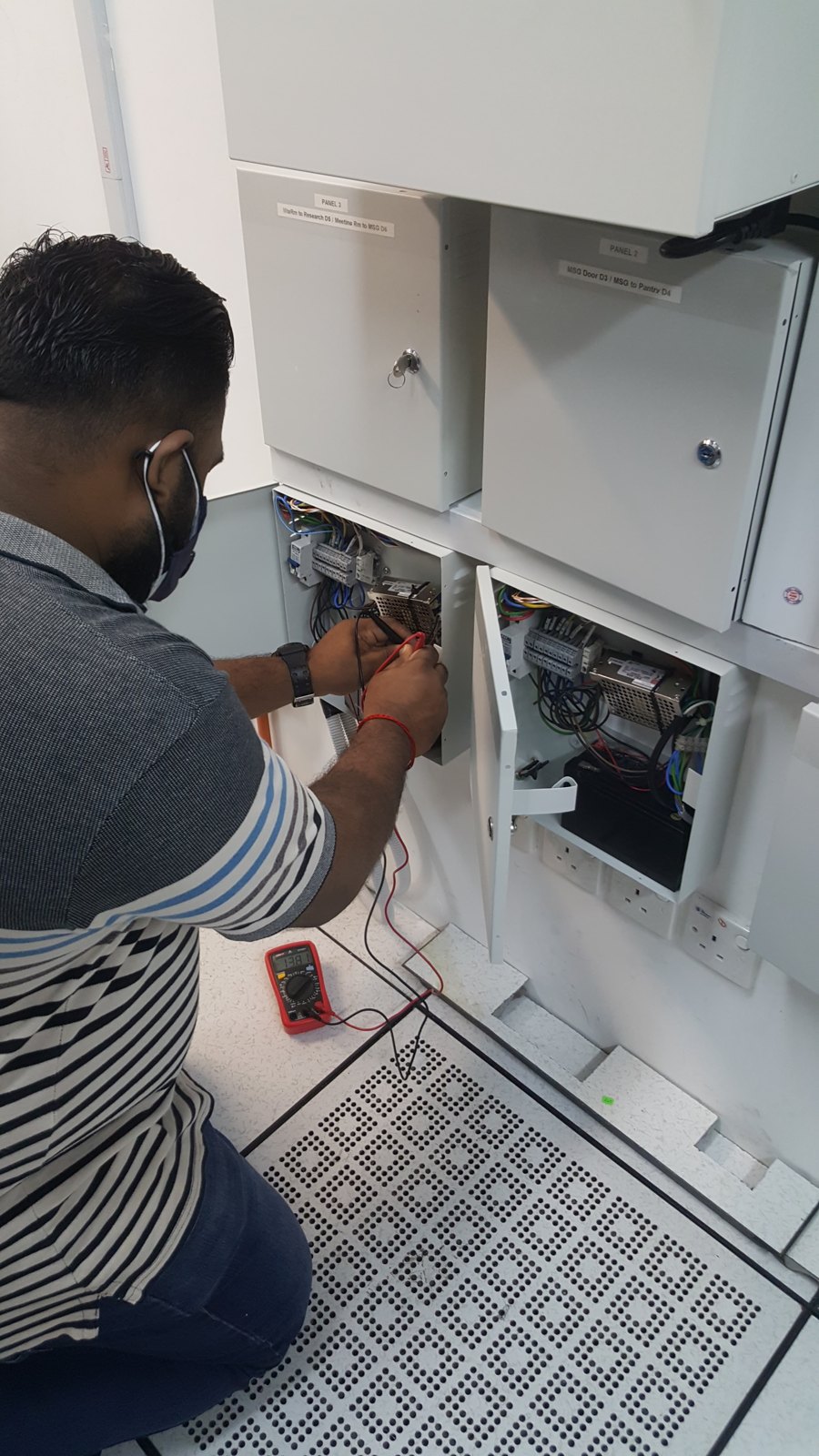
Our electrical and IT teams install, connect and test the system, from door hardware and cabling to servers and software.
Train & hand over
Your security, facilities and HR teams learn to operate the system and manage day-to-day access.
Maintain & upgrade
We stay involved after handover, with maintenance, support and phased upgrades as your needs change.
Governance
Compliance & audit readiness.
We configure access levels, reports and operator roles around your governance requirements from the start. Depending on the selected platform and project scope, this includes:
- Comprehensive audit trails: Records of door events, alarms and operator actions.
- Role-based access control: Operator permissions that limit each site, department or tenant to its own data.
- Segregation of duties: Appropriate distinctions between system administrators, security supervisors and operators to strengthen operational control and accountability.
- Alarm management & standard operating procedures: Procedures attached to alarms to guide operators through each response.
- Security reporting & incident investigation: Detailed reporting for audits, investigations and management reviews.
- Biometric data protection & privacy: Fingerprint and facial data handling, retention policies and system safeguards designed with Malaysia’s Personal Data Protection Act 2010, as amended in 2024, in mind.
For banks, telcos and critical infrastructure operators, this makes it easier to produce evidence for internal audits and regulatory reviews. We set up access levels, reports and operator roles around your governance requirements from day one.
Credential choices
The evolution of Access Control Systems — is your organisation keeping up?
Access has moved from mechanical keys to encrypted cards, biometrics and credentials on phones or smartwatches. Older and newer technologies often coexist within the same organisation.
01
Mechanical keys
02
Swipe cards
03
RFID proximity
04
Smart cards
05
Biometrics
06
Mobile access
Illustrative development sequence. Technologies overlap, and older technologies remain in use alongside newer systems.
| Generation | Technology | What changed | What it means today |
|---|---|---|---|
| Traditional | Mechanical keys | Keys can be lost or copied; changing locks can be disruptive. | No electronic record of who entered or when. |
| Early electronic access | Magnetic stripe and Wiegand swipe cards | Electronic credentials replaced many physical keys. | Legacy sites may face wear, compatibility and maintenance issues. |
| Proximity access | 125 kHz proximity cards | Convenient contactless entry using legacy fixed identifiers. | Assess copying risk and plan a migration where stronger security is needed. |
| Smart credentials | MIFARE, iCLASS, DESFire and Seos families | Cryptographic protection became available; capabilities vary by generation. | Select the credential, reader and security configuration together. |
| Biometrics | Fingerprint and facial recognition | Authentication can check the person presenting for access. | Consider accuracy, presentation-attack resistance and biometric-data protection. |
| Mobile access | Phone, smartwatch and digital-wallet credentials | Credentials can be issued and revoked digitally. | Check device support, authentication policies and platform compatibility. |
Swipe across the table to compare all columns.
Security risk
Review legacy cards and reader configurations, especially where the same badge gives access to sensitive areas.
Operating cost
Consider lost cards, replacements, administration and manual attendance processes across your workforce.
Audit exposure
Check whether the current system produces the records needed for investigations and internal reviews.
Upgrade path
Compatible multi-technology readers can support phased migration, with old and new credentials operating together during the agreed transition.
Match the credential to the risk
Card access vs biometric access control.
The right credential depends on the sensitivity of each area. Many organisations use cards for general entry and fingerprint, face or touchless biometric authentication for more sensitive rooms.
Mobile credentials offer another way to manage access without issuing a physical card. The choice should account for usability, device support, security policies and the needs of each site.
Security & migration
Access cards are not equally secure.
Credential security depends on the card technology, reader configuration, keys and communications. Modern encrypted credentials can substantially improve protection over legacy identifiers, but no product label alone establishes the security of an installation.
| Credential family | Security approach | Migration consideration | Typical assessment |
|---|---|---|---|
| 125 kHz proximity | Legacy fixed identifiers without modern cryptographic authentication. | Prioritise replacement where copying risk is unacceptable. | Existing readers, controlled areas and other protective measures. |
| MIFARE Classic | Legacy CRYPTO1 technology. | Review legacy security limitations and plan stronger credentials. | Installed generation, application and reader support. |
| Legacy HID iCLASS | Earlier-generation smart credentials. | Assess the specific credential and key configuration. | Transition options and reader compatibility. |
| HID iCLASS SE | Secure Identity Object (SIO) protection in supported configurations. | Review the complete reader/credential combination. | Key management, firmware and legacy modes. |
| MIFARE DESFire EV2 / EV3 | Support for AES and mutual authentication. | Configure suitable keys and secure communication. | Platform support and site security requirements. |
| HID Seos & mobile access | Modern cryptographic credentials and supported mobile identities. | Plan enrolment, revocation and reader support. | Credential policy, device compatibility and deployment design. |
Swipe across the table to compare all columns.
Technical references: HID legacy-technology guidance · HID SIO · NXP DESFire EV3
A secure card is only one part of the system.
Many existing access control installations still use 125 kHz proximity cards, outdated credential formats or legacy Wiegand reader connections. Although these systems may continue operating, older proximity cards often rely on fixed identifiers without modern cryptographic protection, increasing the risk of credential cloning.
Traditional Wiegand communication between the reader and controller does not inherently provide encryption or mutual device authentication. Simply replacing an old card with a newer credential may not resolve every vulnerability if the reader, controller interface and overall architecture remain unchanged.
Modern encrypted smart cards, HID Seos credentials and OSDP Secure Channel reader communication can improve security, subject to equipment compatibility and correct configuration. Secure Channel must be enabled and configured; OSDP support alone does not establish an encrypted connection.
That is why we treat card upgrades as a planned migration. Compatible multi-technology readers can accept old and new credentials during the changeover. Once cardholders have migrated, we retire legacy formats, configure site-specific encryption keys where supported, and keep reader firmware up to date as part of ongoing maintenance.
The aim is to improve security while minimising disruption to daily operations.
Common questions
Frequently asked questions.
What is an access control system?
A centrally managed system controls who can enter which doors, and when, across one or many sites. It combines software, controllers, readers, credentials and door hardware, and can integrate with CCTV and HR systems.
Can one system manage all our sites and branches?
Yes. Suitable on-premise and cloud-based platforms can manage multiple buildings and branches centrally, with shared cardholder identities and site-level operator permissions. We confirm capacity, connectivity and operating requirements during assessment.
Should we choose an on-premise or cloud-based system?
It depends on data-hosting requirements, integration needs and how your sites are managed. We assess these with you and recommend the platform that fits.
Can my existing proximity cards be copied?
Many legacy 125 kHz proximity credentials use fixed identifiers without modern cryptographic protection, making duplication a risk. Encrypted alternatives can improve protection when correctly configured. We assess the installed technology and match credentials to each area’s requirements.
Can a new system work with our existing cards and readers?
In many cases, yes. We assess the current setup and plan a phased migration. Compatible multi-technology readers can allow existing and new credentials to work together during the transition.
Talk to our team
Book an access control assessment.
Planning a new headquarters, consolidating multiple sites or replacing an ageing card system? Our team can review your current setup, credential security and audit requirements, then recommend a phased roadmap with clear priorities and budget considerations.